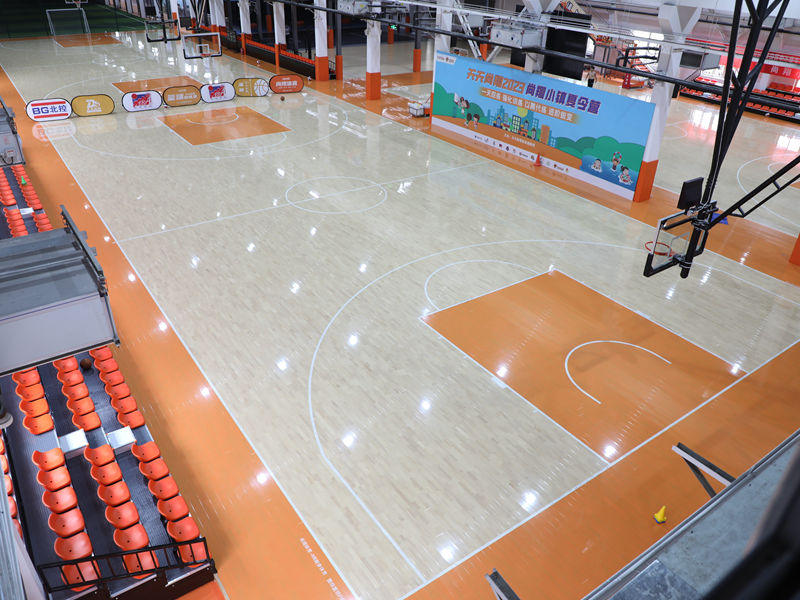
The thermal characteristics of sports wooden flooring have traditionally been viewed as a simple byproduct of material selection, with wood’s natural insulating properties providing a moderate buffer against temperature extremes. Modern printing technology has transformed this passive thermal behavior into an actively engineered property that can significantly impact both athlete comfort and facility energy efficiency. Through advanced material formulations and application techniques, the printed surface layer on modular sports wooden flooring can now be designed to manage thermal energy in specific ways, creating playing surfaces that maintain more consistent temperatures and even contribute to the overall climate control of the sports facility. This represents a fundamental shift from viewing the floor as merely a playing surface to understanding it as an integrated component of the building’s environmental systems.
The thermal regulation begins with the fundamental composition of the printing materials themselves. By incorporating phase-change materials at the microscopic level, manufacturers can create sports wooden flooring surfaces that absorb excess heat during periods of high activity and release it gradually when the facility cools down. These smart materials undergo controlled phase transitions at specific temperature ranges, acting as thermal batteries that smooth out temperature fluctuations throughout the day. For athletes, this means a playing surface that remains comfortably cool even during intense afternoon games when sunlight streams through facility windows, and that doesn’t become uncomfortably cold during early morning practices in minimally heated spaces. The thermal buffering effect is particularly valuable in facilities with variable occupancy patterns, where traditional floors might swing through uncomfortable temperature ranges as heating systems struggle to respond to sudden changes in activity levels.
Infrared reflectivity is another thermal property that can be engineered through the printing process on sports wooden flooring. By carefully selecting pigments and surface textures, manufacturers can create floors that reflect specific wavelengths of infrared radiation, reducing the heat buildup that occurs when floors absorb energy from lighting systems or sunlight. This is especially important in facilities with extensive overhead lighting for televised events, where traditional floors can become significantly warmer than the surrounding air temperature, creating uncomfortable playing conditions and increasing cooling system loads. The printed surface can be tuned to reflect the particular infrared wavelengths emitted by common sports facility lighting while maintaining the desired visual appearance under visible light, creating a cooler playing surface without compromising aesthetic requirements.
The thermal regulation properties extend to the interface between athletes and the floor surface. During high-intensity activities, friction between athletic shoes and the floor generates heat that can sometimes create uncomfortable hot spots or even affect the mechanical properties of the flooring materials. Printed surfaces on sports wooden flooring can be formulated with enhanced thermal conductivity in specific zones, spreading this frictional heat more evenly across the surface and preventing localized temperature spikes. This not only improves athlete comfort but also helps maintain consistent playing characteristics throughout extended competitions, as the floor’s mechanical response remains stable regardless of how much frictional heating has occurred. This sophisticated thermal management represents how printing technology is enabling sports wooden flooring to become an active participant in creating optimal athletic environments rather than merely a passive stage for competition.