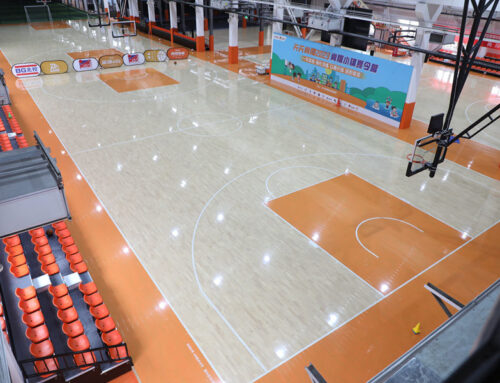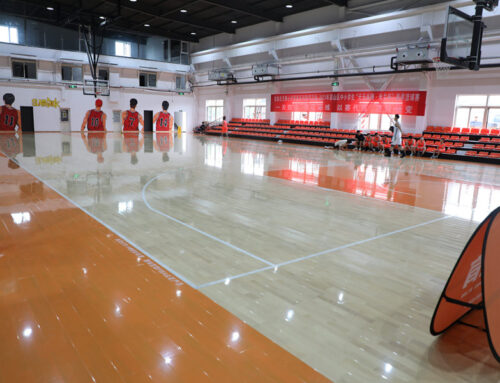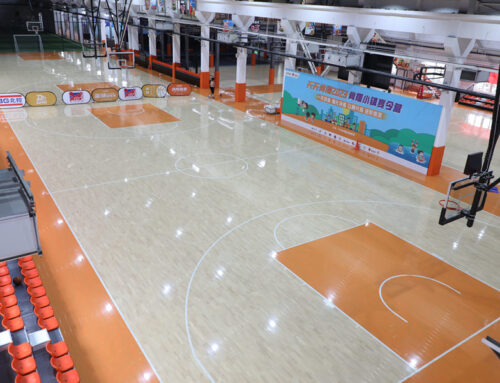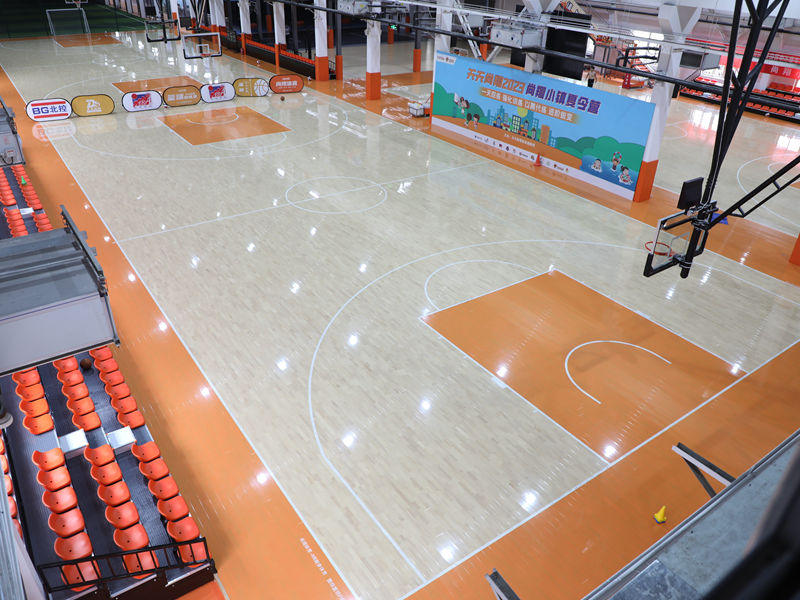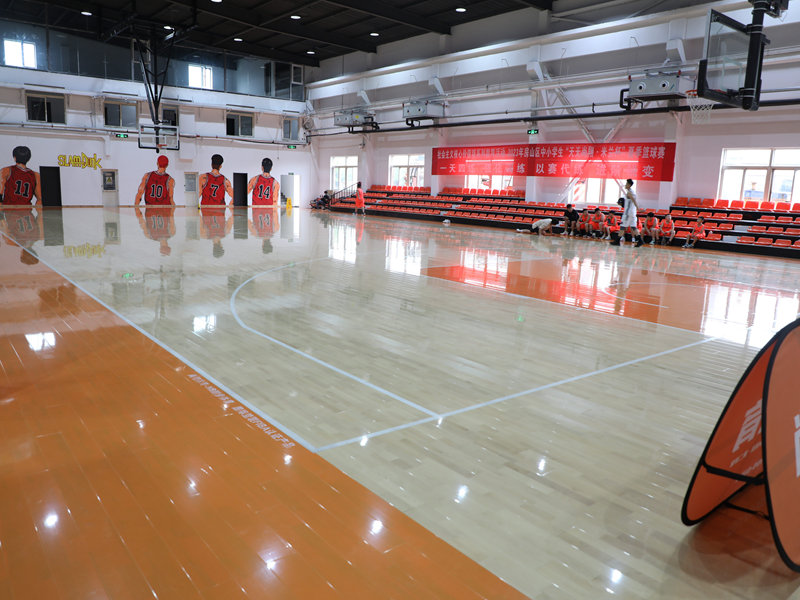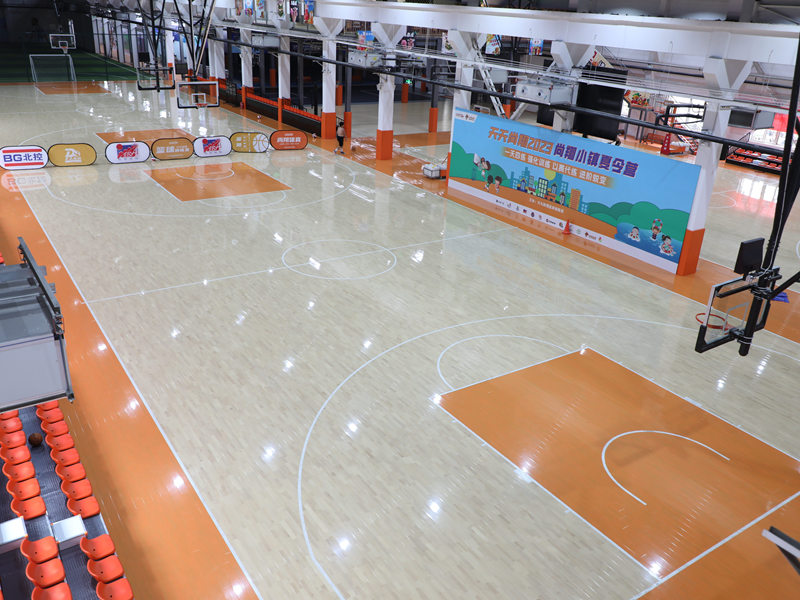
Every basketball player knows the feeling of a perfect game. The ball snaps off your fingertips. Your sneakers grip the surface. You plant your foot, pivot, and drive to the basket without a single hesitation. That feeling is not an accident. It is the result of a meticulously engineered hardwood floor designed to do one thing above all else: let the game happen without the floor getting in the way.
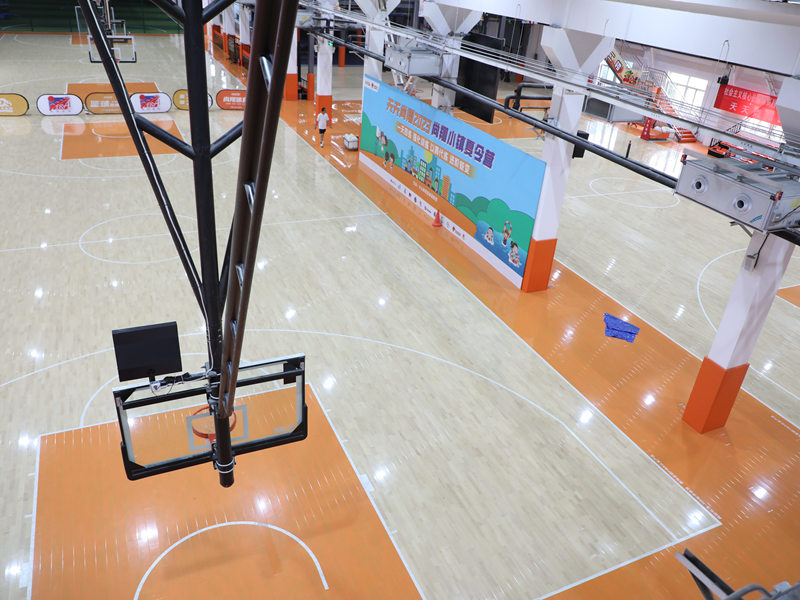
Indoor basketball court hardwood flooring is not the same as the wood you find in a living room or a hallway. It is a purpose-built system, designed from the ground up to withstand forces that would destroy ordinary flooring. When a player lands from a dunk, the impact force on a single square foot of flooring can exceed one thousand pounds. That is roughly five times the player’s body weight, concentrated in one instant on a tiny area. The floor must absorb that force, return energy consistently, and do it thousands of times per game without degrading.
The most commonly used species for this purpose is hard maple, specifically sugar maple. Its Janka hardness rating is approximately fourteen hundred and fifty pounds, making it significantly harder than red oak or white oak. But hardness is only part of the story. Maple has a tight, uniform grain structure that resists splitting, denting, and gouging. When a player makes a sharp lateral cut, the floor must hold firm without tearing. Maple does this exceptionally well. Its light color also provides excellent ball visibility, which is critical for players, referees, and broadcasters.
The construction of a modern indoor basketball court hardwood floor is a multi-layered system. At the bottom, you have the concrete slab, which must be level, clean, and dry. Above that sits a moisture barrier, because moisture is the single greatest threat to hardwood. Above the barrier is the subfloor, typically three-quarter-inch plywood, which provides dimensional stability and a nailing surface. Then comes the shock absorption layer, usually closed-cell foam or rubber pads, which determines how much impact force the floor absorbs. On top of that sits the hardwood itself, typically twenty to twenty-six millimeters thick, installed in a floating tongue-and-groove pattern. Finally, the surface is finished with multiple coats of polyurethane or similar hard finish, followed by court line painting.
Each layer serves a specific function. Remove any one of them, and the entire system suffers. A hardwood floor without proper shock absorption will transfer too much force to players’ joints, increasing injury risk. A hardwood floor without a moisture barrier will cup, warp, or buckle over time. A hardwood floor without a properly prepared subfloor will develop waves, humps, and gaps that ruin ball bounce consistency.
Ball bounce is the single most important performance metric. The standard, set by governing bodies worldwide, requires that a basketball dropped from seventy-two inches must bounce back to a height between forty-nine and fifty-four inches. This must be consistent across the entire court, from baseline to baseline, sideline to sideline. Any variation greater than a few percentage points can affect gameplay, especially at the professional level where inches matter.
Shock absorption is the second critical metric. The floor must absorb between thirty-five and fifty-three percent of the vertical force applied to it. Too little absorption, and players’ joints take the hit. Too much, and the floor feels mushy, ball bounce becomes inconsistent, and players lose agility. The sweet spot is narrow, and maintaining it over the life of the floor requires ongoing attention.
What most people do not realize is that a basketball court floor is a living system. It responds to temperature, humidity, usage patterns, and maintenance schedules. A floor that is perfectly installed can become unsafe if it is not properly maintained. And a floor that is well maintained can last twenty-five to forty years, far outlasting any synthetic alternative.
This is why indoor basketball court hardwood flooring matters so much. It is not a background detail. It is the stage on which the game is performed. Get it right, and the game flourishes. Get it wrong, and everyone suffers, from the players on the court to the facility managers paying the bills.