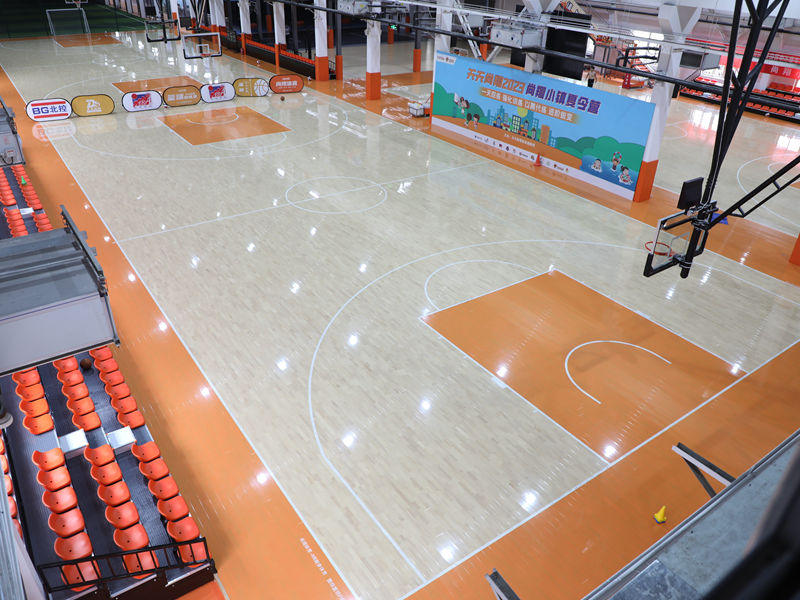
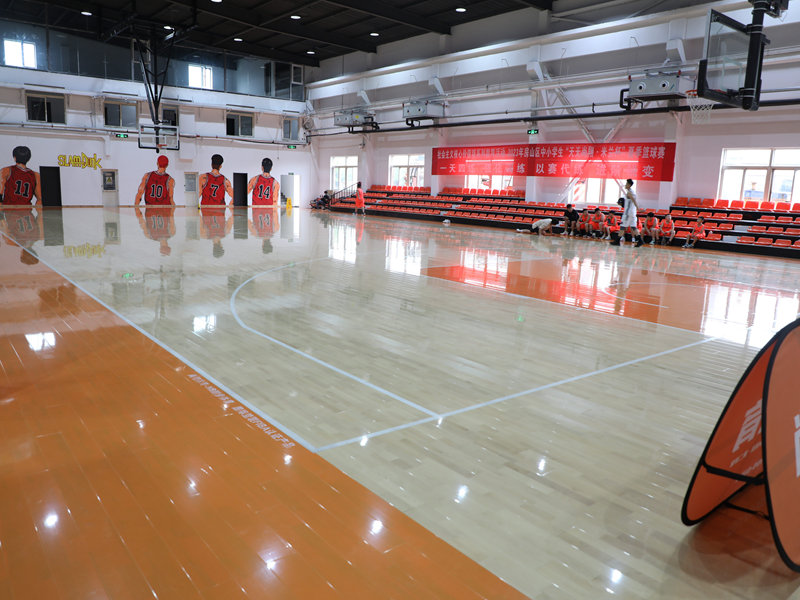
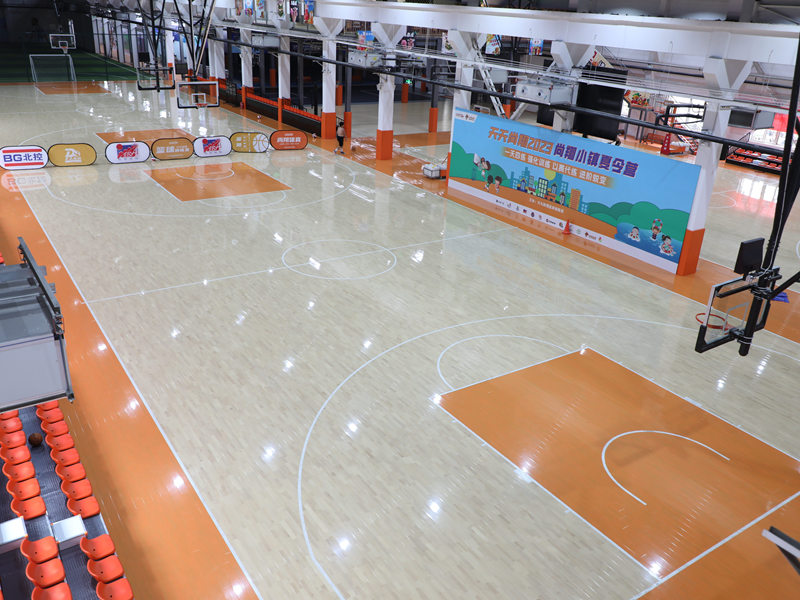
Installing a hardwood basketball court is one of the most complex and precise construction projects you can undertake. Unlike residential hardwood flooring, which can tolerate some level of imperfection, a basketball court demands absolute precision. Every millimeter matters. The floor must be perfectly level, perfectly flat, and perfectly consistent in its performance characteristics. If any of these elements are off, the result is a court that plays poorly, wears unevenly, and potentially injures players.

In this article, we will walk through the complete installation process from start to finish, explaining each step and why it matters.
Step 1: Subfloor Preparation
Everything begins with the subfloor. The subfloor is the structural base on which the hardwood will be installed. In most cases, this is a concrete slab, though it can also be plywood or oriented strand board (OSB) in elevated gymnasium structures.
The subfloor must be completely flat and level. Any high spots, low spots, or uneven areas must be corrected before the hardwood is installed. This typically involves grinding down high spots and filling low spots with a leveling compound. The tolerance for flatness is extremely tight — usually no more than 3 millimeters of variation over a 3-meter span.
Moisture is the enemy of hardwood flooring. The subfloor must be tested for moisture content before installation. For concrete slabs, a calcium chloride test or a relative humidity test should be performed. The moisture content should be below 3 pounds per 1,000 square feet per 24 hours for calcium chloride tests, or below 75% relative humidity for RH tests. If the subfloor is too wet, a moisture barrier must be installed, or the installation should be delayed until conditions improve.
Step 2: Moisture Barrier Installation
Once the subfloor is prepared and deemed dry enough, a moisture barrier is installed. This is typically a polyethylene sheet or a specialized liquid-applied membrane that prevents moisture from the concrete from migrating up into the wood. Without this barrier, the wood will absorb moisture, expand, cup, and warp over time.
The moisture barrier is laid across the entire subfloor and sealed at all seams and edges. It must be completely continuous — even a small gap can allow moisture to seep through and damage the floor.
Step 3: Underlayment and Shock Pads
Next, an underlayment layer is installed. This serves multiple purposes: it provides a smooth surface for the hardwood to sit on, it adds a degree of cushioning, and it helps with sound absorption. In some systems, specialized shock pads are installed between the subfloor and the hardwood to improve player safety by reducing the impact forces transmitted through the floor.
The underlayment is typically made of foam or rubber and is installed in sheets or rolls, depending on the system. It must be laid flat with no wrinkles or bubbles.
Step 4: Hardwood Plank Installation
Now comes the main event: installing the hardwood planks. Basketball court planks are typically 70 to 75 millimeters wide and 18 to 20 millimeters thick. They are installed using either a nail-down method or a glue-down method.
In the nail-down method, the planks are fastened directly to the subfloor using cleats and nails or screws. This method is more traditional and allows for easier future refinishing, as the planks can be removed and replaced individually if needed.
In the glue-down method, the planks are adhered directly to the subfloor using a specialized adhesive. This method creates a more stable, unified surface but makes future refinishing more difficult, as the planks cannot be easily removed.
Regardless of the method, the planks must be installed with precise spacing. Expansion gaps of approximately 6 to 10 millimeters are left around the entire perimeter of the court to allow the wood to expand and contract with changes in temperature and humidity. These gaps are later covered by base molding.
The planks are typically installed in a staggered pattern, similar to bricklaying, to ensure structural stability and even wear distribution. Every plank must be checked for levelness and aligned perfectly with its neighbors.
Step 5: Sanding
Once all the planks are installed, the entire surface is sanded. This is a multi-stage process that begins with a coarse-grit sanding machine to level the surface and remove any high spots, followed by progressively finer grits to achieve a smooth, even finish.
Sanding is one of the most critical steps in the installation process. A poorly sanded floor will show every imperfection and will not provide a consistent ball bounce. Professional installers use large drum sanders and edge sanders to ensure complete coverage.
Step 6: Finishing
The final step is applying the finish. Basketball court floors typically receive a polyurethane finish — either water-based or oil-based. The finish is applied in multiple coats, with sanding between each coat to ensure a smooth, even surface.
The finish serves two purposes: it protects the wood from moisture, dirt, and wear, and it provides the correct level of traction for basketball play. Most courts use a matte or satin finish, as a high-gloss finish can be too slippery and can create glare under arena lighting.
Step 7: Line Painting and Final Inspection
After the finish has cured, the court lines are painted. This must be done with extreme precision, as the lines define the playing area and must meet official dimension requirements. Finally, a thorough inspection is conducted to ensure the floor meets all performance and safety standards.
Conclusion
Installing a basketball court hardwood floor is a meticulous, multi-step process that requires skilled craftsmanship and attention to detail at every stage. From subfloor preparation to final finishing, each step builds on the last to create a surface that will serve players for decades. Cutting corners at any stage will result in a floor that performs poorly and fails prematurely. When done right, however, a hardwood basketball court is a masterpiece of construction that elevates the game itself.