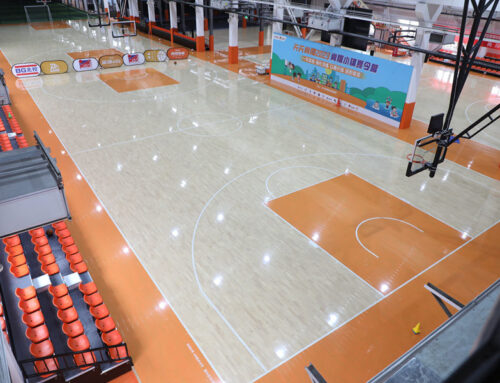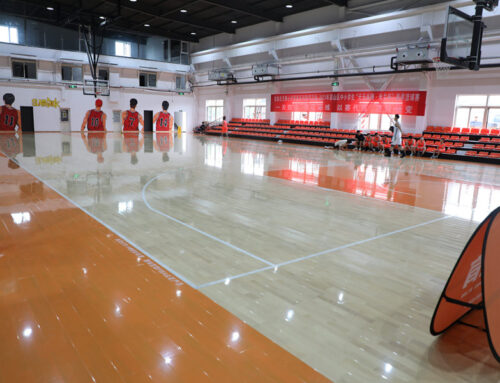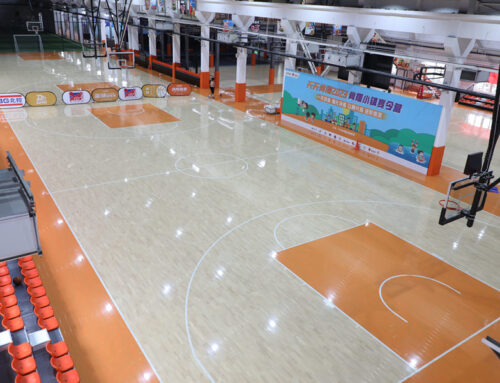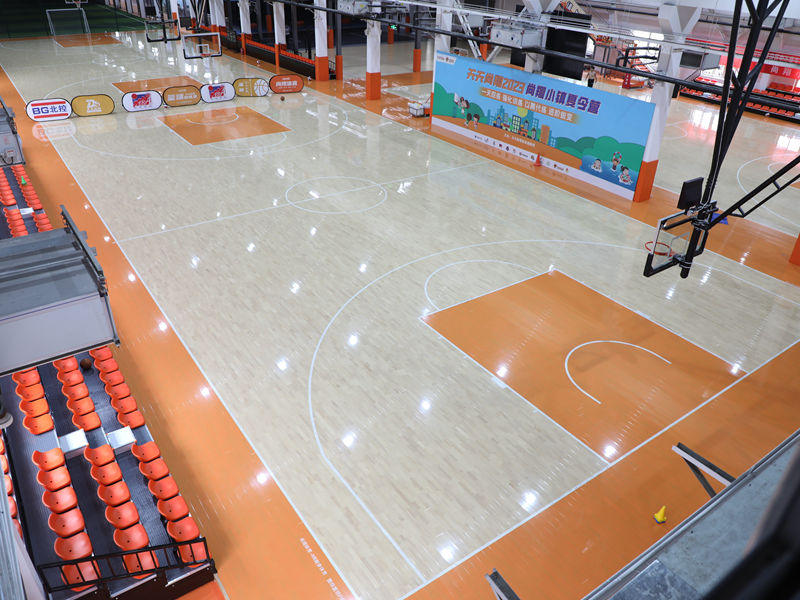
Indoor sports wooden flooring is not just about looks — it’s about performance. Every professional sports organization has strict standards that floors must meet, and these standards are enforced through rigorous testing. In this article, we explore the key performance parameters, the testing methods used, and the international standards that govern sports wooden flooring.
Key Performance Parameters
1. Ball Rebound
Definition: The percentage of energy a ball retains when it bounces off the floor.
| Standard | Required Ball Rebound |
|---|---|
| FIBA (Basketball) | 90-96% |
| NCAA (Basketball) | 90-96% |
| NFHS (US High School) | 90-96% |
| EN 14904 (European) | 90-96% |
| DIN 18032 (German) | 90-96% |
| ITF (Tennis) | 85-95% |
Testing Method: A standardized ball is dropped from a height of 1,800mm (for basketball) onto the floor. The rebound height is measured, and the rebound rate is calculated as a percentage of the drop height.
Why It Matters: Consistent ball rebound is essential for fair play. If the ball bounces too high or too low, it changes the game.
2. Shock Absorption
Definition: The floor’s ability to absorb the impact of an athlete landing from a jump, reducing stress on joints.
| Standard | Minimum Shock Absorption |
|---|---|
| FIBA | 35% |
| DIN 18032 | 35% |
| EN 14904 | 35% |
| NFHS | 35% |
Testing Method: The CKA (Critical Kleine Anna) test or the K cooling test is used. A standardized impactor is dropped onto the floor, and the force transmitted through the floor is measured. The shock absorption is calculated as:
Shock Absorption (%) = (1 – Force transmitted / Force applied) × 100
Why It Matters: Adequate shock absorption reduces the risk of knee injuries, ankle sprains, and stress fractures — the most common injuries in basketball and volleyball.
3. Vertical Deformation
Definition: How much the floor deflects (compresses) under load.
| Standard | Maximum Vertical Deformation |
|---|---|
| FIBA | 2.3mm |
| DIN 18032 | 2.3mm |
| EN 14904 | 2.3mm |
Testing Method: A 1,500N load is applied to a 50cm × 50cm area of the floor, and the deflection is measured.
Why It Matters: Too much deflection makes the floor feel “spongy” and affects ball bounce. Too little deflection means poor shock absorption. The ideal balance is 0.6-2.3mm.
4. Rotational Resistance
Definition: The floor’s resistance to rotational forces (twisting) when an athlete pivots or changes direction.
| Standard | Minimum Rotational Resistance |
|---|---|
| DIN 18032 | 150 Nm |
| EN 14904 | 150 Nm |
Testing Method: A rotational force is applied to a standardized test foot on the floor surface, and the resistance is measured.
Why It Matters: Poor rotational resistance leads to “gripping” of the shoe, which can cause ankle injuries. Good rotational resistance allows the shoe to slide slightly during pivots, as it would on a natural surface.
5. Surface Friction (Traction)
Definition: The grip between the athlete’s shoe and the floor surface.
| Standard | Recommended Friction Range |
|---|---|
| DIN 18032 | 0.4-0.6 (coefficient of friction) |
| EN 14904 | 0.4-0.6 |
Testing Method: A standardized shoe sole is pulled across the floor surface under controlled conditions, and the coefficient of friction is measured.
Why It Matters: Too little friction = slipping. Too much friction = the shoe “grips” and doesn’t slide, leading to knee and ankle injuries. The ideal range provides enough grip for quick starts and stops, while allowing controlled sliding during pivots.
6. Flatness
Definition: The evenness of the floor surface.
| Standard | Maximum Deviation |
|---|---|
| DIN 18032 | 2mm over 2 meters |
| EN 14904 | 2mm over 2 meters |
| FIBA | 2mm over 2 meters |
Testing Method: A 2-meter straightedge is placed on the floor, and the maximum gap between the straightedge and the floor is measured.
Why It Matters: An uneven floor causes inconsistent ball bounce, tripping hazards, and poor athlete performance.
International Standards at a Glance
| Standard | Organization | Scope |
|---|---|---|
| EN 14904 | European Committee for Standardization | Indoor sports flooring (all sports) |
| DIN 18032 | German Institute for Standardization | Sports flooring performance |
| DIN 18032-2 | German Institute for Standardization | Sports flooring — wooden floors |
| FIBA Rules | International Basketball Federation | Basketball court specifications |
| NFHS Rules | National Federation of State High School Associations | US high school sports |
| NCAA Rules | National Collegiate Athletic Association | US college sports |
| ITF Rules | International Tennis Federation | Tennis court specifications |
| IHF Rules | International Handball Federation | Handball court specifications |
Testing Equipment
Professional testing requires specialized equipment:
| Equipment | Purpose | Cost |
|---|---|---|
| Ball Rebound Tester | Measures ball bounce | $2,000-5,000 |
| CKA Device | Measures shock absorption | $15,000-30,000 |
| Vertical Deformation Tester | Measures floor deflection | $5,000-10,000 |
| Rotational Resistance Tester | Measures pivot resistance | $10,000-20,000 |
| Friction Tester (BOT) | Measures surface traction | $5,000-10,000 |
| Flatness Measuring System | Measures floor evenness | $1,000-3,000 |
Certification Process
To get a floor certified, the process typically involves:
- Pre-installation testing: Test the subfloor for flatness, moisture, and structural integrity.
- Post-installation testing: Test the finished floor for all performance parameters.
- Third-party verification: An independent testing lab (e.g., Sports Labs Ltd., DIN CERTCO) conducts the tests.
- Certificate issuance: If the floor meets all standards, a certification certificate is issued.
- Annual re-testing: Most certifications require annual re-testing to maintain validity.
Conclusion
Performance testing is the backbone of sports wooden flooring quality. Every parameter — from ball rebound to rotational resistance — is designed to maximize athlete performance and safety. When specifying a sports wooden floor, always require third-party certification to an recognized international standard.