One of the most attractive features of interlocking wooden flooring is that it can be installed without professional help. While hiring a crew is always an option, many facility managers and homeowners have successfully completed the installation themselves, saving significant money on labor costs. This article provides a practical guide for anyone considering a DIY installation of an indoor basketball court using interlocking wooden panels.
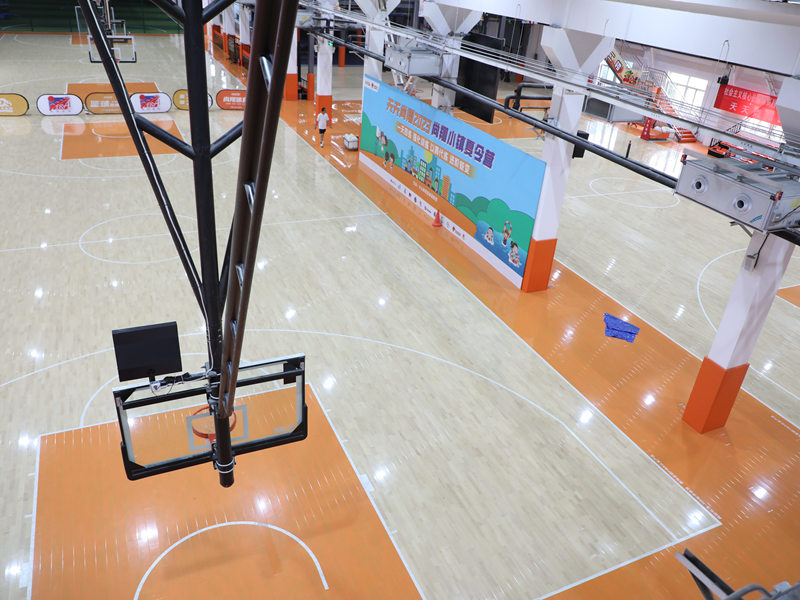
Before you begin, gather your tools. You will need a tape measure, a pencil, a straightedge, a utility knife or fine-toothed saw, rubber mallet, spacers, and a broom or vacuum for cleaning the subfloor. That is it. No nail gun, no adhesive, no specialized equipment. The simplicity of the tools required is a testament to how user-friendly this system is.
Step one: Measure the room. You need to know the exact length and width of the space where the court will be installed. Use these measurements to calculate how many panels you will need. It is always a good idea to order 5 to 10 percent extra panels to account for cuts and mistakes.
Step two: Prepare the subfloor. This is the most important step. The subfloor must be clean, dry, flat, and free of any debris. Sweep or vacuum thoroughly. If the subfloor is concrete, check for moisture as described in previous articles. If it is plywood, make sure all seams are supported and the surface is smooth. Apply underlayment if required by the flooring system.
Step three: Plan your layout. Decide which direction the panels will run. For a basketball court, the most common orientation is with the long edge of the panels running parallel to the sidelines. This creates a clean, professional look and ensures that the joints do not interfere with play. Mark the starting point and the direction on the floor with chalk.
Step four: Begin laying the first row. Start in the corner farthest from the door. Place spacers along the walls to maintain the expansion gap. Lay the first panel, then connect the second panel by aligning the tongue and groove and pressing firmly until you hear the click. Continue across the row.
Step five: Cut panels as needed. When you reach the end of a row, you will likely need to cut the last panel to fit. Measure the remaining space, mark the panel, and cut with a fine-toothed saw. Always measure twice and cut once.
Step six: Stagger the joints. Each new row should be offset so that the joints do not line up with the joints in the previous row. This is called a running bond pattern, and it adds both strength and visual appeal.
Step seven: Continue until the entire court is covered. Work methodically, checking each connection as you go. Use the rubber mallet to tap panels into place if they are not clicking properly.
Step eight: Remove the spacers and install the baseboards or trim to cover the expansion gap. This completes the installation.
A DIY installation of a standard indoor basketball court can typically be completed in a long weekend by two people. The savings on labor alone can be substantial, making this a highly rewarding project for anyone willing to put in the effort.