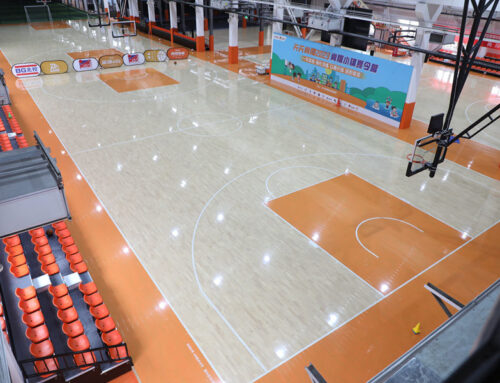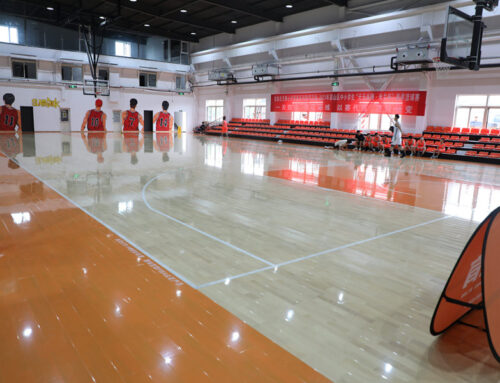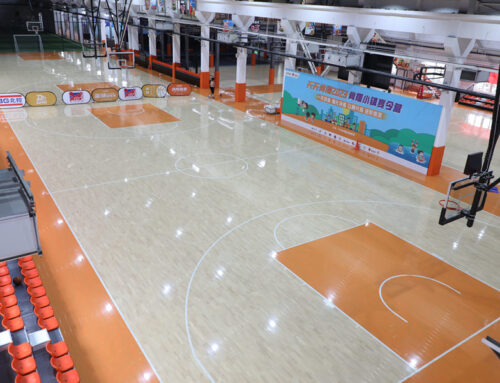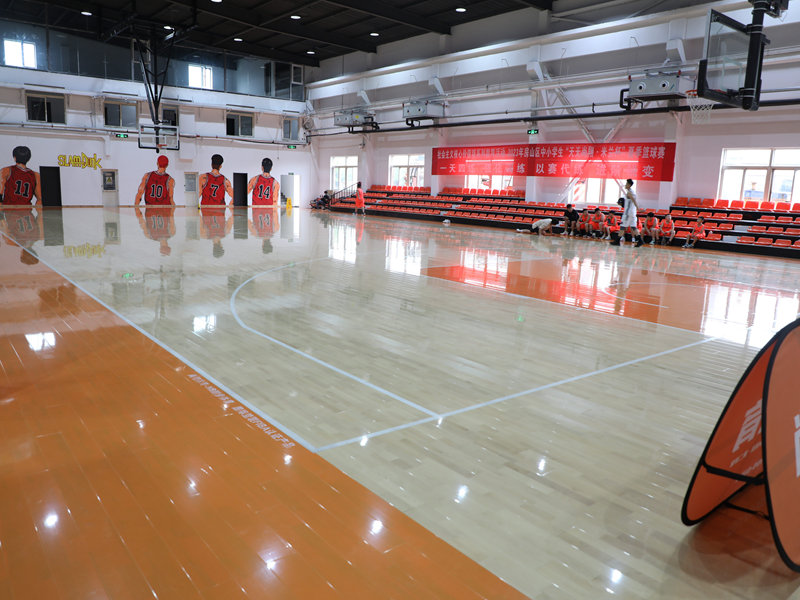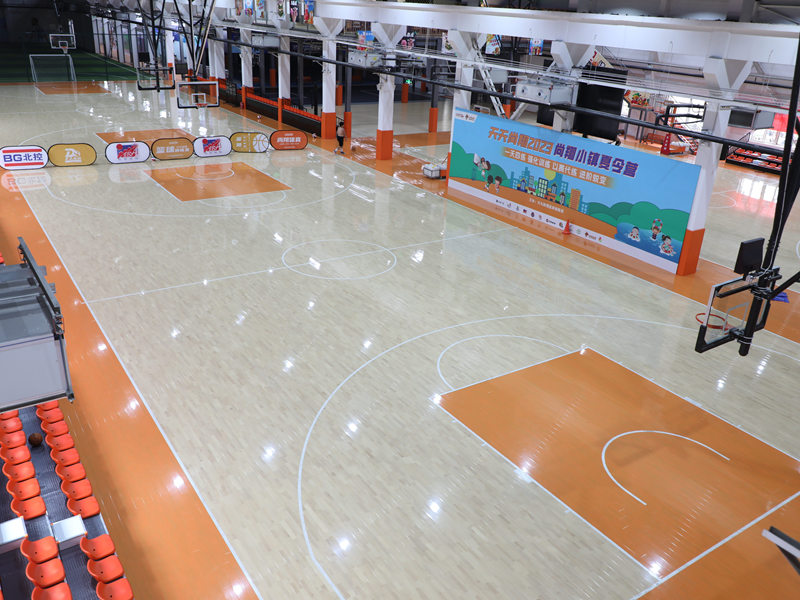
Gymnasium floors used to be purely functional—a plain maple surface with some painted lines. But today, facility owners and architects treat gymnasium flooring as a design element, using wood species, plank widths, finishes, and court markings to create stunning spaces that inspire athletes and impress visitors.
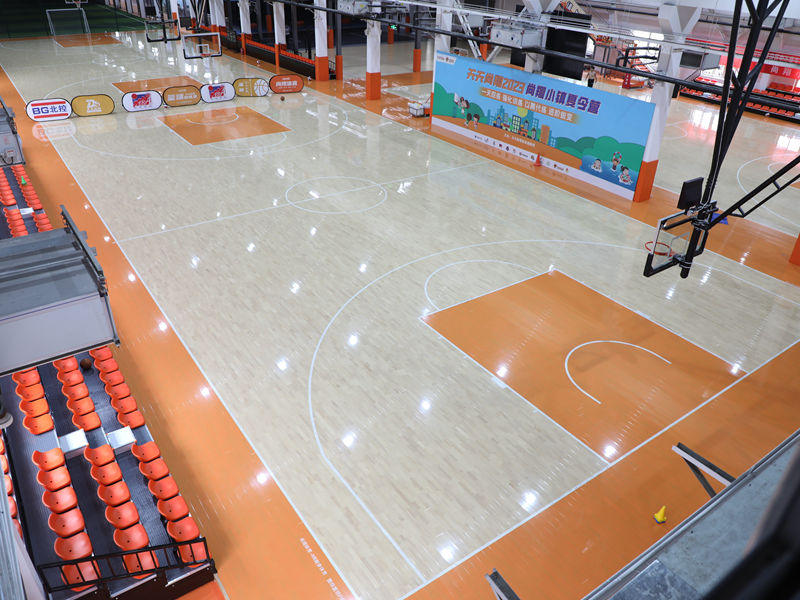
In this article, we’ll explore the latest design trends in gymnasium wooden flooring.
Trend 1: Wide Plank Maple – The Luxury Look
The biggest trend in gymnasium flooring is wide plank maple. While standard planks are 2-2.25 inches wide, luxury installations use gaining traction:
- Honey/amber tint: Warm, inviting tone that’s slightly darker than natural maple
- Gray/driftwood: Weathered, modern look achieved through specialized finishing
- Team colors: Some facilities stain or paint sections in school/team colors (requires removable finish systems)
- Ombré effects: Gradual color transition from light to dark across the court
Important note: Any colored finish must maintain the required friction and shock absorption. Darker finishes can be slightly more slippery, so testing is essential.
Trend 4: Recessed and Inlaid Court Lines
Painted lines are the standard, but they wear and need repainting. Premium facilities are using:
- Recessed lines: Lines cut into the floor and filled with contrasting wood (oak in maple, walnut in birch). Permanent, beautiful, never fades.
- Inlaid logos: School mascots, team logos, or sponsor logos inlaid in contrasting wood. Popular in college and professional facilities.
- Routed patterns: Decorative borders and patterns routed into the floor surface.
Cost impact: Recessed lines add $3-8/sq ft to installation costs. Inlaid logos are custom-priced.
Trend 5: Sustainable and Natural Aesthetics
The sustainability movement is influencing gymnasium design:
- Live-edge accents: Natural, un-milled wood edges used for benches, bleacher fronts, or decorative borders
- lights can damage finish, and fixtures must not create tripping hazards).
Trend 7: Multi-Sport Versatility
Rather than dedicated courts for each sport, modern facilities use:
- Convertible markings: Tape or paint systems that allow quick court reconfiguration
- Zone flooring: Different floor textures or colors for different sports zones
- Overlay systems: Removable sports mats over wood for badminton, pickleball, etc.
Popular Design Combinations for 2024
| Facility Type | Recommended Design | Estimated Cost |
|---|---|---|
| Elementary School | Natural maple, 2.25″ planks, blue/red accents | $14-18/sq ft |
| High School | Wide plank maple (3″), school colors inlay | $16-22/sq ft |
| Community Center | Maple/oak two-tone, recessed lines | $15-20/sq ft |
| College/University | Premium maple, inlaid logo, LED accents | $20-30/sq ft |
| Corporate Wellness | Bamboo/maple, natural finish, minimalist | $18-25/sq ft |
| Professional Arena | Select maple, UV finish, custom inlays | $25-40/sq ft |
How to Work with a Designer
If you’re planning a new gymnasium or renovation:
- Hire a sports flooring consultant who understands both design and performance
- Get samples of wood species, finishes, and court line options
- Create a mock-up (3×3 foot sample installed in the actual space) before committing
- Test the mock-up for ball bounce, friction, and appearance under your facility’s lighting
- Balance aesthetics with performance—a beautiful floor that doesn’t perform well is a failed investment
Conclusion
Gymnasium flooring has come a long way from plain maple planks with painted lines. Today’s facilitiesimum 3/8″ rubber, targeting 53% shock absorption (DIN K3)
- Finish: UV-cured or high-performance water-based polyurethane
- Ball bounce: 90-100% (ball dropped from 72″ bounces 49-54″)
- Surface friction: 0.4-0.6
- Flatness: ±1/16″ per 10 feet (stricter than most standards)
NBA Testing Requirements:
Every NBA floor must be tested by an independent lab using:
- Clegg Impact Tester: Measures shock absorption (G-max rating)
- ASTM F2772: Standard test method for measuring surface friction
- ASTM F355: Drop test for vertical deformation
- ASTM F2398: Ball bounce test
Tests are conducted:
- Before the season starts
- After any floor repairs or refinishing
- Annually during the season
NBA Maintenance Protocol:
- Daily: Dust mopping, spot cleaning
- Weekly: Wet mopping with pH-neutral cleaner
- Monthly: Deep cleaning with low-speed buffer
- Every 4-5 years: UV recoat (or every 3 years for polyurethane)
- Every 12-15 years: Full sanding and refinishing
Famous NBA Floors:
- Boston Garden/TD Garden: The original parquet floor (1946-present, refinished multiple times)
- Madison Square Garden: Installed in 196 Maple preferred, beech or oak acceptable
- Plank width: 2″ to 2.25″
- Shock absorption: 35-50% (DIN K1-K2 for training, K3 for competition)
- Ball bounce: 90%+ (measured at 1.8m drop height)
- Surface friction: 0.4-0.65
- Flatness: ±1/8″ per 10 feet
FIBA vs. NBA differences:
- FIBA courts are slightly smaller (28m × 15m vs. NBA’s 28.65m × 15.24m), so floor dimensions differ
- FIBA allows more wood species (beech is popular in Europe)
- FIBA’s shock absorption requirements are slightly lower than NBA
Olympic Floors:
Olympic basketball floors are the pinnacle of sports flooring:
- Custom-designed for each host city
- Often feature national cultural elements in the design
- Tested to both FIBA and NBA standards
- Installed in temporary or permanent Olympic venues
The Tokyo 2020 Olympic basketball floor, for example, featured a unique wave pattern inspired by Japanese art, installed over a custom shock pad system.
Other Professional Leagues
WNBA: Follows NBA specifications (same arenas, same floors)
EuroLeague (European basketball): Follows FIBA specs, often with oak or beech floors
Volleyball (FIVB):
- Shock absorption: 35-
- Community centers (DIN K1-K2)
- Residential courts (DIN K1 or similar)
When you install a floor to NBA specs in a high school gym, you’re getting a floor that exceeds the requirements for any level of play below professional. It’s future-proofing your investment.
Conclusion
Professional sports have driven gymnasium flooring innovation for decades. The NBA’s insistence on maple floors, shock absorption testing, and performance standards has raised the bar for every facility in the world. When you walk into an NBA arena and feel that perfect bounce under your feet, you’re experiencing the culmination of 70+ years of flooring science and engineering.
Whether you’re building a pro arena or a school gym, understanding these professional standards helps you make better flooring decisions—and gives you bragging rights when someone asks, “Why is your gym floor so good?”