No sports wood floor lasts forever. But it does not need to be replaced every five years either. With proper refinishing and repair, a good floor can serve a facility for 15 to 20 years. Understanding when and how to refinish is one of the most important things a facility owner can learn.
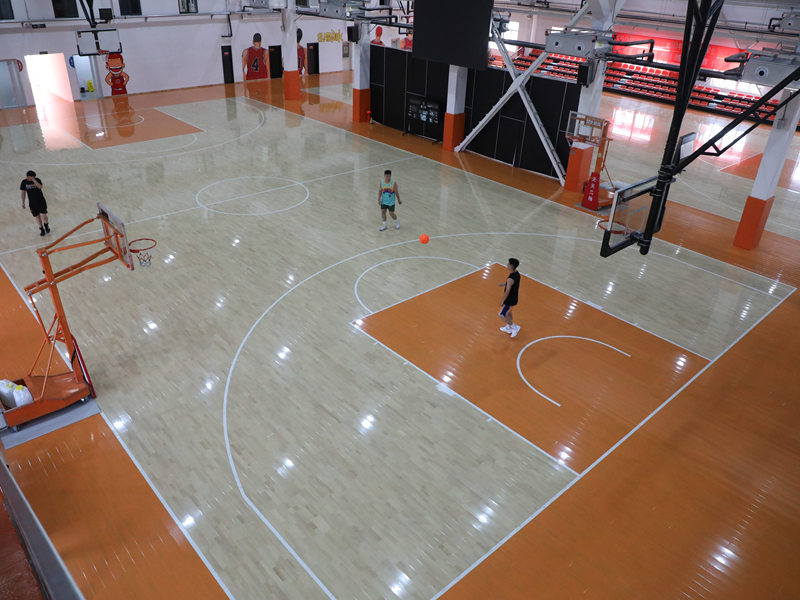
Refinishing is the process of sanding down the old finish, applying a new primer and topcoat, and restoring the friction surface. It does not involve replacing any panels or structural components. It is essentially giving the floor a new skin while keeping the structural system intact.
The sign that a floor needs refinishing is not cosmetic. A floor can look fine on the surface but have lost its friction and shock absorption properties. The real indicators are: the ball bounce has changed, the friction coefficient has dropped below 0.4, the finish shows visible wear in high-traffic areas, or the surface feels smooth and slippery underfoot.
The refinishing process takes about three to five days for a standard gymnasium. The floor must be empty during this time. First, the old finish is sanded off using a drum sander or edger. The surface is cleaned of all dust. A primer coat is applied and allowed to dry. Then two to three coats of finish are applied, with sanding between each coat. The final coat includes the friction treatment. After the finish cures, the floor is tested for ball bounce, shock absorption, and friction.
The cost of refinishing is typically 150 to 400 per square meter, depending on the extent of the work. This is a fraction of the cost of full replacement, which can be 600 to 1200 per square meter or more. Refinishing every four to five years is the most cost-effective maintenance strategy for most facilities.
Repair is different from refinishing. Repair addresses localized damage: a dented panel, a cracked panel, a loose panel, or a damaged section of finish. Individual panels can be replaced without disturbing the rest of the floor. This is possible because sports wood floors are floating systems. The damaged panel is lifted out, the structure is checked, and a new panel is laid in its place. The new panel is then finished to match the surrounding surface.
The key principle is: refinish before you need to, and repair immediately when you see damage. Waiting until the floor looks bad before refinishing means you have already lost performance. And ignoring small damage means it will spread. Proactive maintenance is always cheaper than reactive repair.