Introduction: More Than Just a Surface
Walk into any professional basketball arena, and you will see polished wood gleaming under the lights. Players explode off the floor, land from towering dunks, and change direction in the blink of an eye. What you might not see—but what the players certainly feel—is the complex interplay of physics, material science, and engineering that makes that floor work.
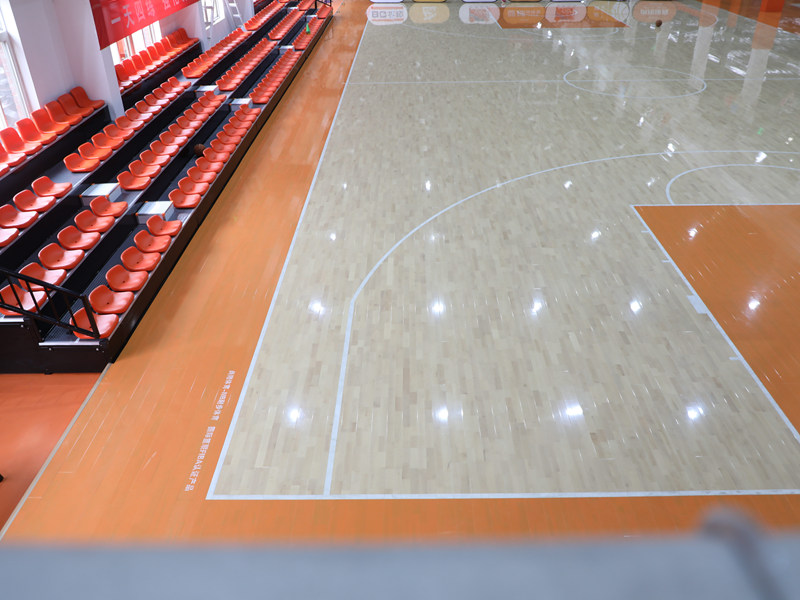
Indoor basketball court hardwood flooring is not a passive surface. It is an active participant in the game, influencing everything from how high a ball bounces to how much stress a player’s knee absorbs on a landing. Understanding the science behind these interactions is essential for architects, engineers, facility managers, and anyone involved in designing, specifying, or maintaining a basketball court.
In this article, we will dive deep into the performance science of basketball court hardwood floors. We will explore shock absorption and energy return, ball response and surface stiffness, player biomechanics and injury prevention, moisture dynamics and dimensional stability, and the testing standards that govern court flooring quality.
Part 1: Shock Absorption and Energy Return
What Is Shock Absorption?
Shock absorption refers to the floor’s ability to reduce the impact forces transmitted to a player’s body when they land from a jump or make a hard stop. It is measured as a percentage: a floor with 50% shock absorption reduces the impact force by half.
The concept is straightforward—when a player lands, their body generates a force that travels through their legs, into the floor, and then back. A floor with good shock absorption deforms slightly under load, absorbing some of that energy and returning it gradually rather than all at once. This reduces the peak force experienced by joints, tendons, and ligaments.
The Role of the Subfloor and Cushioning
Shock absorption is not solely a function of the hardwood surface. The entire floor system—including the subfloor, any underlayment, and the finish—contributes to the overall performance.
The Subfloor Effect:
A plywood subfloor installed over closely spaced joists (12 inches on center or less) provides a springy, responsive feel. The plywood flexes slightly under load, contributing to shock absorption. In contrast, a subfloor installed over widely spaced joists (16 inches or more) will feel “dead” and transmit more impact force to the player.
Underlayment Systems:
Some installations incorporate foam or rubber underlayment between the subfloor and the hardwood to enhance shock absorption. This is more common in multi-purpose gymnasiums where the court must also accommodate volleyball, badminton, or other sports with different performance requirements.
However, for basketball specifically, too much cushioning can be detrimental. Excessive shock absorption reduces energy return, making the floor feel “mushy” and slowing down players. The ideal basketball court floor provides enough cushioning to protect joints while still feeling firm and responsive.
Energy Return
Energy return is the complement of shock absorption. It measures how much of the impact energy is returned to the player as they push off the floor. High energy return means the floor feels “lively” and supports quick, explosive movements.
The relationship between shock absorption and energy return is a trade-off. A floor that absorbs 60% of impact energy might only return 30% of it (the rest is lost as heat). A floor that absorbs only 30% might return 50%. For basketball, the sweet spot is typically:
- Shock absorption: 35–50%
- Energy return: 40–55%
These values are measured using standardized tests like ASTM F355 (Standard Test Method for Measuring Shock Absorption of a Sport Surface) and EN 14904 (European standard for sports flooring).
DIN and Area Deflection
In Europe, basketball court performance is often specified using DIN (Deutsches Institut für Normung) standards. The DIN value measures the deflection of the floor under a standardized load, expressed in millimeters. A DIN value of 2.0–3.5 mm is typical for basketball courts.
Area deflection is another measurement that assesses how much the floor deflects over a given area when a load is applied. This is important because basketball players don’t land on a single point—they land on the ball of their foot, which distributes force over a small area. The floor must deflect consistently across the entire surface to ensure uniform performance.
Part 2: Ball Response and Surface Stiffness
Why Ball Response Matters
Imagine playing on a court where the ball bounces high in one corner and dead in another. Or where the ball skips unpredictably off a slightly warped board. Ball response consistency is fundamental to fair play and player confidence.
Ball response is determined by the surface stiffness of the floor—essentially, how much the floor deforms when the ball hits it. A stiffer floor deforms less, resulting in a higher, quicker bounce. A softer floor deforms more, resulting in a lower, slower bounce.
The International Standard
The international standard for ball bounce on a basketball court is defined by the governing bodies of the sport. According to FIBA (International Basketball Federation) and NCAA regulations:
- When a basketball is dropped from a height of 1.80 meters (5.9 feet), it should bounce back to a height of 1.20–1.40 meters (3.9–4.6 feet).
- The difference in bounce height between any two points on the court should not exceed 10 mm (about 0.4 inches).
This 10 mm tolerance is stringent and requires precise installation. Variations in subfloor flatness, plank thickness, adhesive coverage, or moisture content can all cause localized differences in ball response.
Surface Stiffness Measurement
Surface stiffness is measured using a device called a Clegg Impact Tester (also known as a portable hammer tester). A calibrated hammer is dropped onto the surface, and the deceleration is measured. The result is expressed in gravities (g). For basketball courts, a Clegg value of 35–50 g is typical.
Higher Clegg values indicate a stiffer surface (less deflection, higher ball bounce). Lower values indicate a softer surface (more deflection, lower ball bounce).
The Role of Finish Thickness
The thickness and type of finish applied to the floor can significantly affect ball response. A thick buildup of polyurethane (more than 3–4 mils dry film thickness) can make the floor feel slightly softer and reduce ball bounce. Conversely, a thin, hard finish (like UV-cured) can make the floor feel very crisp and responsive.
This is one reason why professional arenas often use thinner finishes (2–3 coats) compared to residential installations (5–7 coats). The professional floor prioritizes performance over maximum durability, since the court will be refinished regularly anyway.
Part 3: Player Biomechanics and Injury Prevention
The Forces Involved
Basketball is one of the most physically demanding sports in terms of lower extremity loading. During a typical game, a player may make 200–300 jumps, land 1,000+ times, and change direction hundreds of times. The forces involved are enormous:
- Jump landing: 4–8 times body weight
- Sudden stop: 3–5 times body weight
- Lateral cut: 5–7 times body weight
For a 200-pound player, that means forces of 800–1,600 pounds on each landing. The floor is the first line of defense in managing these forces.
Common Basketball Injuries Related to Flooring
Several common basketball injuries are directly or indirectly influenced by the playing surface:
- Ankle sprains: Often caused by uneven surfaces or insufficient traction. A floor with inconsistent friction or localized soft spots can cause a player’s foot to roll unexpectedly.
- Patellar tendinopathy (Jumper’s knee): Caused by repetitive high-impact loading. A floor with poor shock absorption increases the cumulative stress on the patellar tendon.
- Stress fractures: Tiny cracks in the bones of the foot or shin, caused by repetitive impact. Harder surfaces (like concrete) increase the risk compared to wood.
- Plantar fasciitis: Inflammation of the tissue on the bottom of the foot, often exacerbated by surfaces that don’t provide adequate support.
How Hardwood Reduces Injury Risk
Compared to harder surfaces (concrete, tile) or softer surfaces (foam mats, rubber), hardwood occupies an optimal middle ground:
| Surface Type | Shock Absorption | Energy Return | Injury Risk |
|---|---|---|---|
| Concrete | 0–5% | 90%+ | Very High |
| Ceramic Tile | 5–10% | 85%+ | High |
| Synthetic Sport Tile | 15–25% | 60–70% | Moderate |
| Hardwood (properly installed) | 35–50% | 40–55% | Low |
| Foam Mat | 60–80% | 10–20% | Moderate (due to instability) |
Hardwood provides enough shock absorption to reduce peak impact forces while maintaining enough energy return to keep the surface stable and responsive. This combination minimizes both acute injuries (sprains, strains) and chronic overuse injuries (tendinopathy, stress fractures).
Traction and Friction
Traction—the grip between a player’s shoe and the floor—is equally important. Too little traction leads to slipping; too much can cause the foot to “stick” and the knee to torque when changing direction.
The ideal coefficient of friction for a basketball court is:
- Static COF: 0.4–0.6 (resistance to initial sliding)
- Dynamic COF: 0.3–0.5 (resistance during sliding)
These values can be affected by:
- Finish type: High-gloss polyurethane tends to be more slippery than satin finishes.
- Contamination: Dust, sweat, and cleaning residues can drastically reduce traction.
- Shoe type: Different basketball shoes have different outsole compounds that interact differently with the floor.
Facility managers should regularly test the floor’s friction using a portable slip meter (like the BOT-3000 or similar) and adjust cleaning protocols accordingly.
Part 4: Moisture Dynamics and Dimensional Stability
Wood Is Hygroscopic
All wood absorbs and releases moisture from the surrounding environment. This property—called hygroscopicity—means that hardwood flooring will expand and contract with changes in temperature and humidity. Understanding and managing this behavior is critical for basketball court performance.
Expected Movement
A typical 3/4-inch maple plank, 2.25 inches wide, will expand or contract approximately 1/32 inch per 10 feet for every 5% change in moisture content. In a gymnasium with poor climate control, humidity swings of 20% or more are not uncommon, which could result in movement of 1/8 inch or more—enough to cause cupping, crowning, or gapping.
Cupping, Crowning, and Gapping
- Cupping: The edges of the plank rise higher than the center, creating a concave shape. This is caused by moisture absorption on the bottom or edges of the board (often from subfloor moisture).
- Crowning: The center of the plank rises higher than the edges, creating a convex shape. This is caused by moisture loss from the top surface (often from low humidity or excessive drying).
- Gapping: Boards separate from each other, creating visible gaps. This occurs when the wood dries and contracts.
All three conditions affect ball response, create tripping hazards, and compromise the floor’s appearance. They can be minimized but not entirely eliminated—which is why proper acclimation, moisture control, and installation techniques are so important.
Acclimation
Before installation, hardwood planks must be acclimated to the environment where they will be installed. This typically means storing the planks in the building for 48–72 hours, stacked with spacers to allow air circulation on all sides. The wood should reach equilibrium with the room’s temperature and humidity before being nailed or glued down.
Failure to acclimate properly is one of the most common causes of flooring problems. Wood that is installed too dry will absorb moisture from the subfloor or air and expand, leading to crowning. Wood that is installed too wet will dry out and contract, leading to gapping.
Moisture Barriers
As discussed in the previous article, a moisture barrier between the subfloor and the hardwood is essential, especially over concrete slabs. Common options include:
- 15-lb felt paper: Economical and effective for most applications.
- 6-mil polyethylene sheeting: Better moisture resistance, commonly used over concrete.
- Liquid-applied membranes: Provide the highest level of moisture protection but add cost and installation time.
Part 5: Testing Standards and Certifications
ASTM Standards
The American Society for Testing and Materials (ASTM) has developed several standards relevant to basketball court flooring:
- ASTM F2772: Standard Practice for Design and Installation of Wood Flooring Systems for Basketball. This is the primary guide for basketball court installation in North America.
- ASTM F355: Standard Test Method for Measuring Shock Absorption of a Sport Surface.
- ASTM F1913: Standard Test Method for Measuring the Coefficient of Friction of a Sport Surface.
- ASTM F2153: Standard Test Method for Measuring the Force Reduction of a Sport Surface.
EN Standards (European)
In Europe, the relevant standards include:
- EN 14904: Sports flooring—Wooden flooring for sports use with multi-functional use.
- EN 914: Sports flooring—Determination of shock absorption.
- EN 14905: Sports flooring—Determination of ball bounce.
DIN 18032
The German DIN standard specifically addresses sports flooring performance. It classifies floors based on:
- DIN value: Deflection under load (mm)
- K value: Force reduction (percentage)
- W value: Energy absorption (percentage)
For basketball, a typical specification might be DIN 2.0–3.5, K 35–50%, W 30–45%.
FIBA and NCAA Approval
Professional and collegiate basketball organizations have their own approval processes for court flooring. FIBA, for example, requires that courts meet specific ball bounce, shock absorption, and friction criteria. Courts that host FIBA-sanctioned events must be tested and certified by an approved laboratory.
Part 6: The Future of Basketball Court Flooring Technology
Engineered Wood Products
Advances in engineered wood technology are producing flooring products that offer improved dimensional stability. Multi-layer engineered planks, with alternating grain directions, resist cupping and crowning better than solid wood. While not yet standard for professional basketball courts, these products are gaining traction in training facilities and schools.
Smart Flooring
Emerging technologies are beginning to integrate sensors into basketball court floors. Pressure-sensitive flooring can track player movement, measure jump height and landing forces, and provide real-time biomechanical data to coaches and trainers. While still in early stages, this technology has the potential to revolutionize player development and injury prevention.
Sustainable Alternatives
Bamboo flooring, while technically a grass rather than wood, has emerged as a sustainable alternative for basketball courts. Bamboo is harder than most hardwoods (Janka 1,380–1,540), grows rapidly, and is highly renewable. Some manufacturers now offer bamboo flooring that meets professional basketball court standards.
Cork-based composite flooring is another emerging option. Cork provides excellent shock absorption and is completely renewable. However, its ball response and durability characteristics are still being refined for high-performance applications.
Conclusion
The science behind basketball court hardwood flooring is as fascinating as it is complex. Every layer of the floor system—from the subfloor to the finish—plays a role in shock absorption, energy return, ball response, traction, and player safety. Understanding these principles empowers facility managers to make informed decisions, a safer, more enjoyable playing surface for athletes at every level.
The next time you watch a basketball game, take a moment to appreciate the floor beneath the players’ feet. It is a marvel of material science and engineering, working silently to protect athletes and enhance the beautiful game.