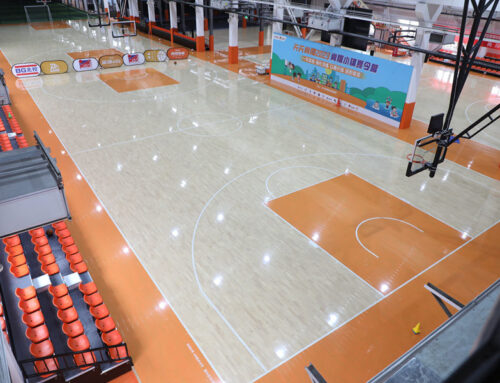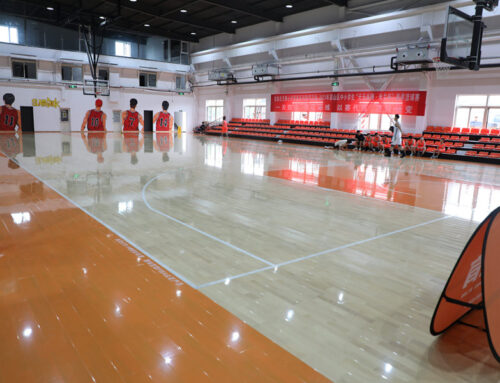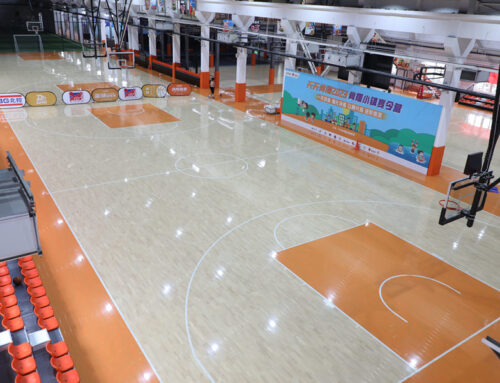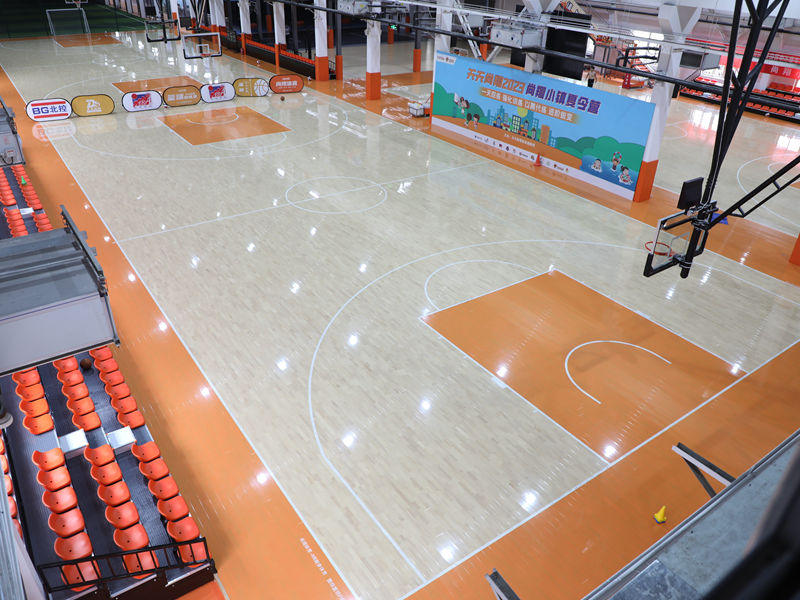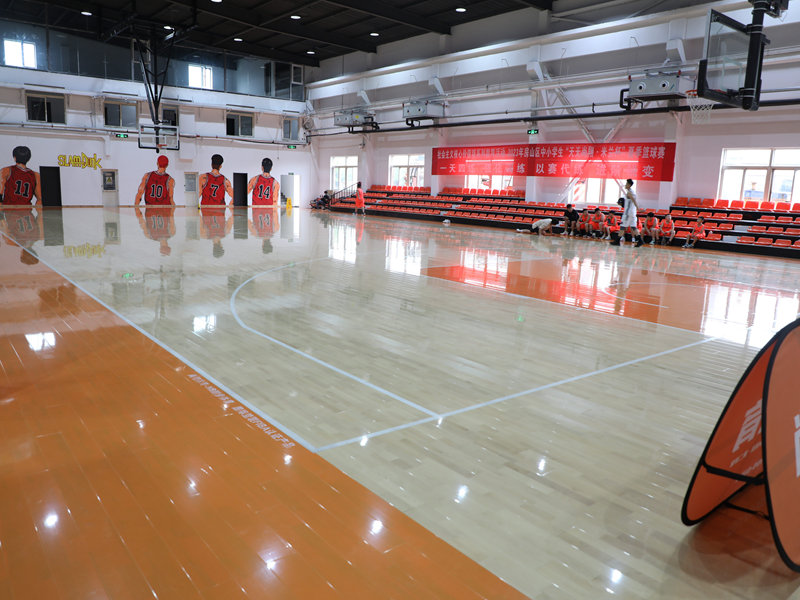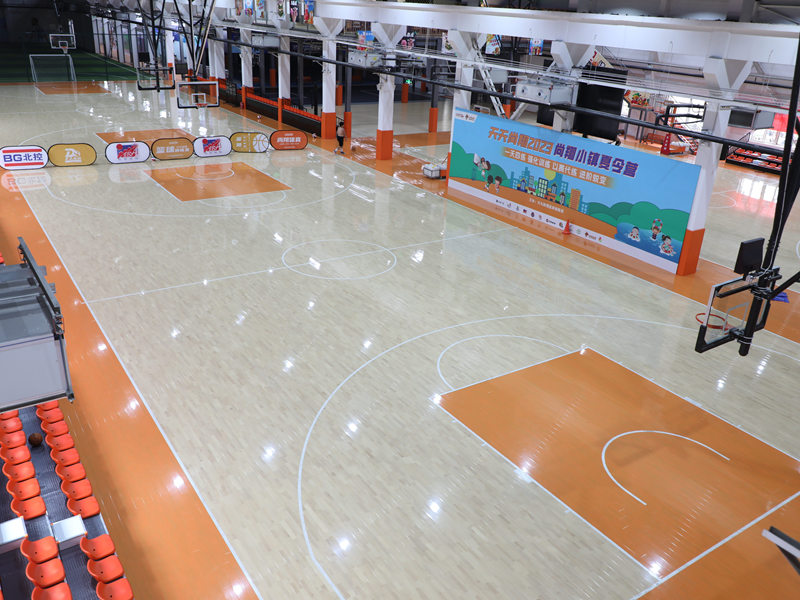
The installation process of portable indoor basketball court wood flooring does not require complex professional tools, and the whole process can be completed efficiently as long as the operators follow the standardized steps. Before starting the formal laying, the first step is to carry out a comprehensive cleaning of the target indoor ground. The staff needs to use a hard broom to sweep away all the gravel, sawdust and other hard sundries on the ground, and then wipe the ground with a damp mop to remove dust and oil stains. This step is very critical, because any hard particles left under the flooring may pierce the bottom moisture-proof mat during use, causing local protrusions on the flooring surface and affecting the flatness of the entire court.
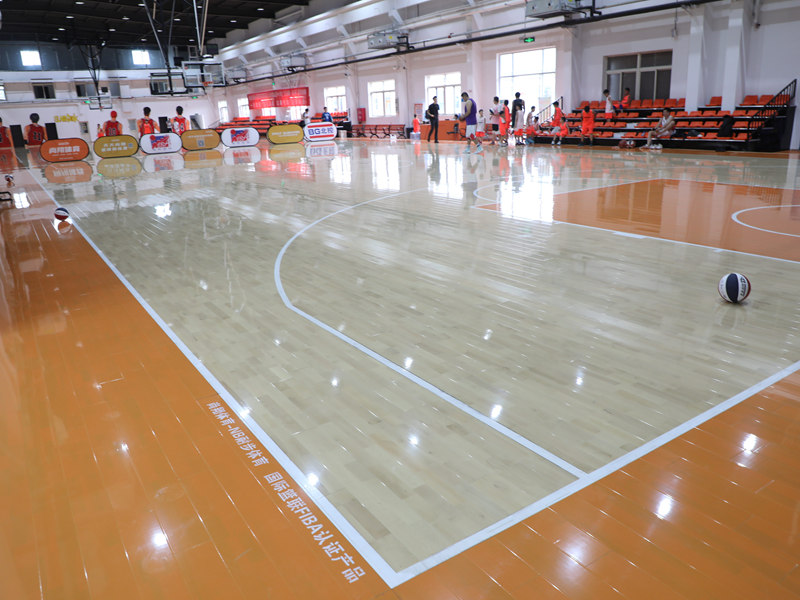
After the ground is completely dry, the staff will first lay a layer of unified shock-absorbing underlayment on the cleaned ground. This underlayment is usually made of a flexible polymer material, which is cut according to the size of the basketball court in advance, and the joints between the underlayments are tightly connected with special adhesive tapes. This layer of underlayment can not only further adjust the slight unevenness of the original ground, but also form a whole shock-absorbing system with the subsequent wooden floorings, ensuring that the elasticity of the entire court is consistent without local soft or hard areas.
Next comes the formal laying link of the portable indoor basketball court wood flooring. The staff will first select a corner of the venue as the starting point, and align the locking structures on the sides of the first flooring unit with the adjacent units. With a light tap of a special rubber hammer, the splicing parts can be completely engaged, so that there is no gap between the two floorings. During the laying process, the staff will check the flatness of the surface with a level gauge at any time, and adjust the position of the floorings slightly to ensure that the seams between all units are tight and the surface has no obvious height difference. When laying to the edge of the venue, the staff will cut the excess part of the flooring with a precision cutting tool to make it perfectly fit the boundary of the court.
After all the wooden floorings are laid, the staff will carry out the painting work of the court lines. Unlike the line painting on fixed wooden floors that uses permanent paint, the lines on portable indoor basketball court wood flooring usually use special removable sports marking tapes. These marking tapes have moderate viscosity, which can be firmly attached to the surface of the wooden flooring without falling off during the game, and will not leave residual glue that is difficult to clean when the flooring is disassembled later. The staff will use professional measuring tools to position the three-point line, free throw line, center circle and other areas of the court strictly according to the standard basketball court size, to ensure that the size of the venue fully meets the requirements of the event.
The disassembly process of portable indoor basketball court wood flooring is the reverse process of installation, but there are also some details that need special attention. First of all, the staff needs to tear off the marking tapes on the surface of the flooring slowly to avoid scratching the non-slip coating on the surface of the wood due to excessive force. Then, use a special pry bar to gently pry open the splicing part of the edge flooring, and then separate the connected floorings one by one along the laying direction. During the handling process, the staff should avoid dragging the flooring on the ground, and should hold the edge of the flooring with both hands to lift it, so as to prevent the bottom of the flooring from being worn by the gravel on the ground.
After the disassembly is completed, each portable indoor basketball court wood flooring unit needs to be inspected briefly. The staff will wipe off the sweat stains and dust on the surface with a soft dry cloth, check whether the splicing locking structure is deformed, and then stack the floorings neatly in the designated storage box. The storage environment should be kept dry and ventilated, avoiding direct sunlight and contact with humid walls, which can extend the service life of the flooring to the greatest extent and ensure that the flooring can still maintain excellent performance in the next use.